Root Work
In Gandum Village, Portugal, a group of people came together to learn how to regenerate the systems we work in. Outside in the yard, an olive tree was doing the same work. Not far away, an ancient olive tree has been doing it for 3,712 years.
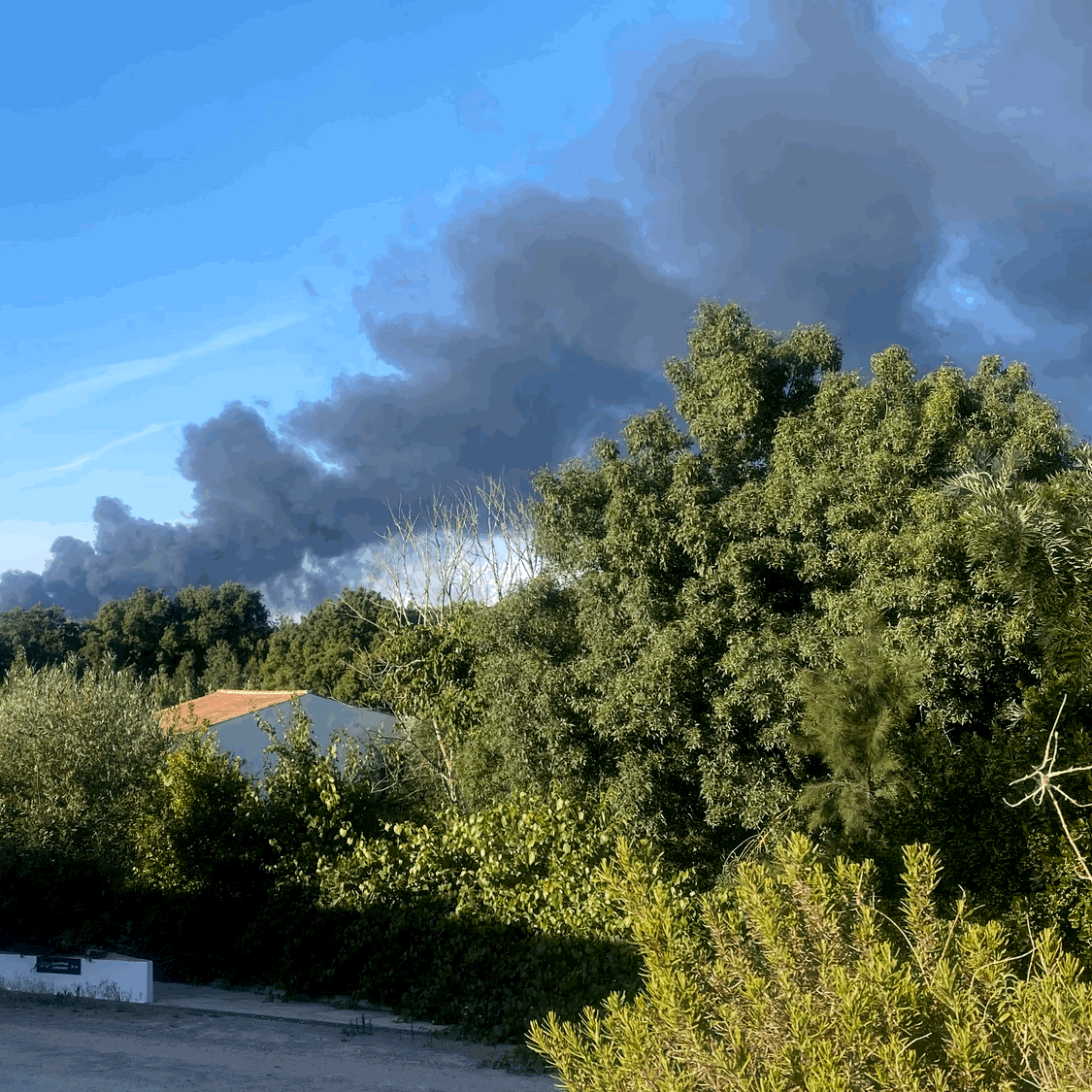
In the region of Alentejo, where the heat is dry and the water scarce, ancient olive trees inhabit the land. The sky is blue today, and in the distance, smoke is rising. A wave of hot air from North Africa is pushing temperatures across the Iberian Peninsula to the highest levels of rural fire risk.
I wonder how many fires these olive trees have watched pass through. How many have they survived.
Not far from where I am staying, at a conscious hotel nested in an agroforestry project, stands one of the oldest olive trees in the country.
In Vidigueira, it has been living for 3,712 years. A tree so voluminous its heart has grown hollow. The thick, gnarled trunk has taken the shape of an old witch. Age has split the bark over and over, twisted, braided, until roots and trunk have grown to one.
Once, though, when people gathered wild olives for fuel, the tree of Vidigueira was as young as the one that is lending me a shadow right now.
Its branches tickle my skin, protecting me from the hot midday sun, while I work through the exercise we were given in small breakout groups. After twenty minutes, it is time to go back inside, to the co-working space, with walls made of rammed earth. Like olive trees, they can last for centuries, regulating both heat and cold in this climate.
We circle together, some standing, some stretched out on the floor, most settled into chairs. The youngest among us might be twenty-four; others are married with children. Some teach, others study. We work in fashion, construction, sustainability, tourism - like me. Some have founded businesses, others are just beginning. All of us from different land.
In each of their words, I find pieces of myself.
The room is cool and silent, our minds still sitting with the question. Someone speaks, shares a reflection. The rest of us listen.
Since February, we had been meeting online every two weeks; this was the first time we had been in the same room for a four-day intensive.
The question is always how. How do you initiate change? What does it actually take?
"Aren't we circling too much around the self?" someone in the group asks. He uses the word ego, and I understand why.
In the very same moment, outside, the olive tree deepens its roots. Olive tree roots grow slowly, but they never really stop moving.
In the evening, some of us stand together in an attempt to define the word discernment, and in that very moment, I observe myself, as if I were watching myself from the outside, and yet inside, I freeze.
A familiar pattern in moments where I am asked quickly to give a stand. I am leaving my body, run by the mind, generating thoughts that have nothing to do with the topic but with my own fear of being wrong, of saying something silly. And so I would rather stay small or silent than try, or on the other side of the coin, overexplain.
That night, I am imaging the eleven-year-old dancing in the sand, fully in her body, moving before thought could intervene, and the woman standing in the circle, trying to catch the right words.
Discernment and reflection are not the same. Discernment happens in the present moment, alive in the body and mind as they speak to each other before one takes control. Reflection needs space. It comes after, when I revisit what happened and analyze it from a distance. This, I know, I am good at.
Somewhere along the way of becoming, the systems I had been part of taught me that taking less space was less risky. Smaller was safer than being wrong. And my mind had forgotten that my body thinks too.
Throughout the days, I notice, every time we begin working on the outside, we pivot back to the inside. As if the two were in constant back and forth, a ping pong play that never stops. Because that is the point.
An olive tree cannot offer its fruit without first growing its roots. There is no sequence to the offering, the growing, or the holding of soil. The tree works at all three levels without choosing between them.
What my colleague called "centring the ego" is perhaps just this: the discomfort of discovering that we are also the system we are working on. The olive tree standing outside in the yard, purposefully curated into tiles, mirrors our circle. Conditioned, learning the ground it has been given, it is the same work as that of the ancient tree. Carrying food, light, medicine, and oil in its nature. It grows and gives without judging or dividing into good and bad.
As I am writing this, a new wave of heat from North Africa has bent into a giant loop that traps a heavy lid of high pressure over Europe, blocking cooler storms from moving in, and in the very same moment, I am watching from my balcony the glacier ice melting into a fast-flowing stream of water.
Patterns are not fixed. They change, they adapt. The tree of Vidigueira holds 3,712 years of stories; it has watched generations of the same families tending to each individual tree, stewarding and protecting in return for gifts. Over time, the reciprocal partnership shifted, and monocultures replaced the montado landscape of cork oaks, wild olive trees, and natural pastures.
The agroforestry project where we gathered to practice regeneration is a response to that extractive way of doing. Each evening at dinner, Miguel, the kitchen chef, feeds us from the land: olives harvested from the trees around us, paired with fresh bread and a savory homemade olive paste.
The roots grow into the dark and wider, extending outward, beyond the canopy of silver leaves.
I have been there — my feet grounded, my shoulders straight — standing behind the reception desk when a difficult guest raises their voice. I take a breath, I speak.
I hope something in these letters moves inside you, even quietly. Thank you for your attention and your time. It is a gift to be connected through words.
With love, Zaza