Familiar Yet New
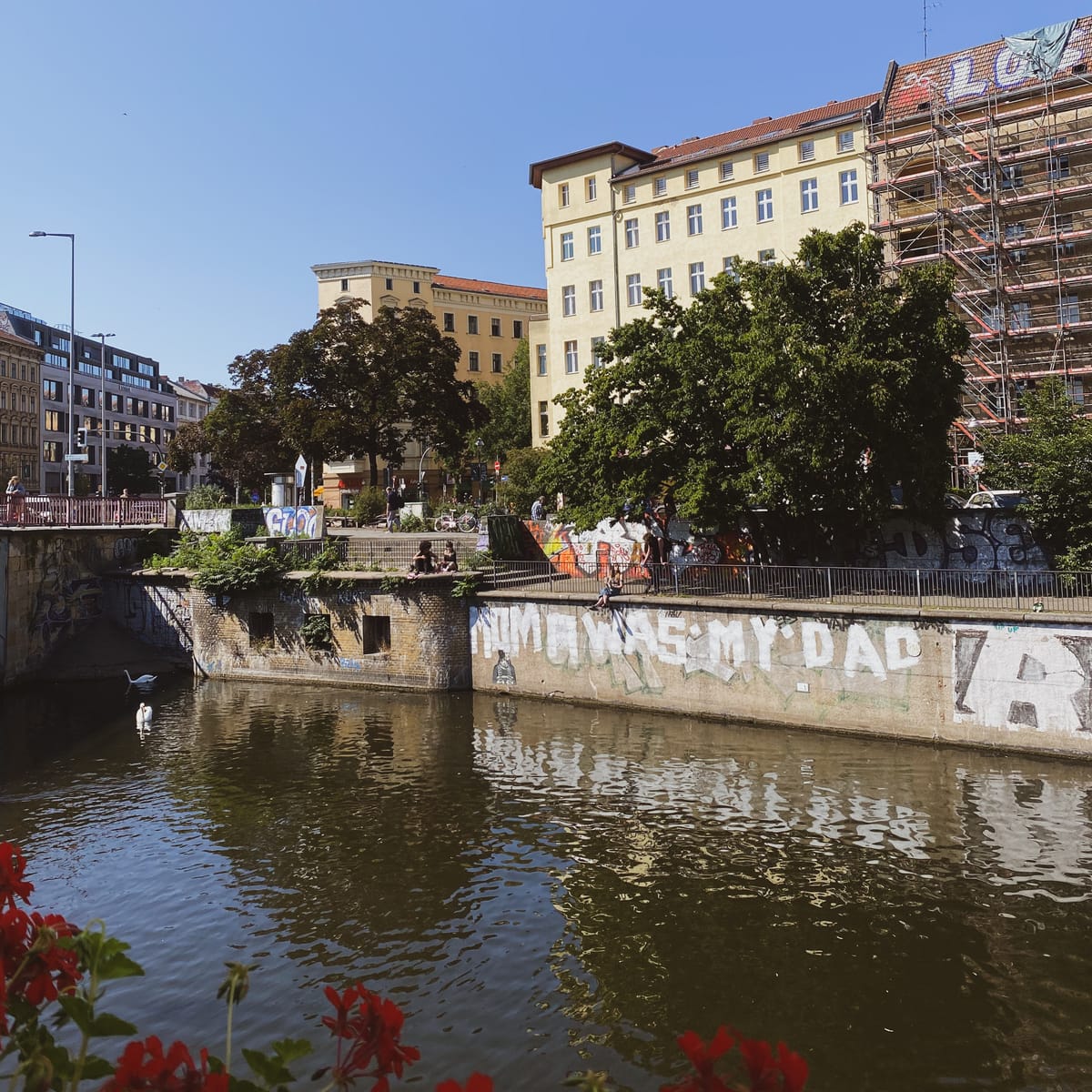
There is no other city in Europe like Berlin in the summer. Berlin summers are people hanging out in cafés, restaurants, and bars, in parks, along the river, in boats, on balconies, and on rooftops. People who dance, bike, swim, play, and talk. Berlin in summer makes one happy, and being here, I realized how much I missed it.
For the past two years, we mostly visited in November, when the city is painted in a wet, misty grey that lingers over grey buildings and between grey streets. November is cold rain beating against my legs and face. And crowded, smelly public transport. November is grim faces.
I suppose that is why the last time I was here, it was easy to say, "I don't like it here anymore."
Visiting family and friends simply feels different in open spaces, and the wine tastes better in June.
Every time I come back, I ask myself if I could imagine living here again, returning for good.
Now, having tasted Berlin's summer again, my love for this special city has developed into a new stage. I would call it intimate, unconditional. A healthy but long-distance relationship.
This awareness and gratitude for the place that gave birth to me brings me a sense of peace.
While in Berlin, I began reading The Regenerative Life by Carol Sanford, a book that is profoundly transforming my understanding of life.
Carol Sanford, who passed away six months ago, was a regenerative educator and visionary thinker. Her work invites us to reimagine how we live, lead, and engage with systems.
One of her key contributions is the Seven First Principles of Regeneration, a framework for systemic thinking, interconnectedness, and regenerative practice across business, community, and personal development.
Part of these seven principles is Nestedness, which is the understanding that every system we are part of is nested in a larger one. I am nested in my relationship, in my family. We used to be nested in the culture of Friedrichshain and Prenzlauer Berg. Those districts are part of Berlin's landscape. Berlin is a system situated within Germany, Germanywithin the European climate, and Europe within the global context.
Each of these systems has its own unique culture, dynamics, and relationships, yet they interrelate and all influence who I am and how I experience life.
Berlin has a distinctive essence, like every living system has its own energy, a frequency. Living here has profoundly shaped the way I relate to the world, and I'm learning to own that.
We are often quick to judge the places that gave birth to us, or go to the other extreme and glorify them.
We build an identity around where we are from: customs, traditions, values. And yet, while I feel Berlin's parenting within me, I also feel fluent, capable of unlearning and learning.
Maybe clearer than ever, I see the potential of travel as a means to see how much of my thinking is preconditioned by my own cultural and personal lens.
It is easy to believe something to be true, even when it may not be true for someone else standing in the same place, and even less so for someone interacting with a completely different environment.
Examining Berlin through its historical, cultural, political, and economic context helps me understand why I perceive certain things the way I do.
That doesn't make my perspective right or wrong; it simply creates more space to listen. To hold complexity without the urge to fix it.
As much as I dislike the color grey in Berlin's November, I wish there were more grey in the world.
We tend to simplify things. To pick a side. To be a good person, we are told, is to make the right choice.
What if the right choice is not right for everyone? What if we held two or more truths at once?
What might shift if we stopped needing everything to fit into a binary or a category?
In today's public discourse, we are often taught that if you criticize one thing, you are defending another. That if you stay neutral, you are complicit. That seeing complexity means you are unclear about your values.
Where does this leave us? In constant judgment - of others and of ourselves.
What if, instead, we observed, listened, and accepted?
What if we began to think for ourselves again? Breaking our habitual thought patterns, rather than continuing a culture where politicians, experts, coaches, and influencers shape and define the boundaries of our thinking?
Reflecting on Nestedness also brought me to another layer: belonging.
For as long as I can remember, I haven't felt I belonged in my home country. Because of its present racism. Because of the fascist past. Because of the emotional distance in German culture. A government that struggles to differentiate. The arrogance. The hypocrisy.
The shame I felt still exists.
Europe, too, is easy to judge. For its double standards and its pretense.
And yet, I am beginning to see not only the problems but also the potential.
Europe is a complex ecosystem of countries, cultures, and languages. While some predict its downfall, many European countries still offer a high quality of life, accessible healthcare, quality education, and various environmental efforts.
In many places, there's still a culture of relationships. A culture of walking instead of driving. A culture of slow food and sitting in cafés just because.
The social problems we face — alienation, inequality, burnout, and the economic challenges of finding affordable housing and decent jobs — are ingrained in a global, highly capitalistic system and political corruption that prioritizes profit over people and the planet.
But the potential exists, too.
Berlin is as beautiful as it is because of the elements that have shaped it. It has always been a nexus of counterculture. A place of resistance. And that culture of resistance has also shaped me.
Berlin, like all living systems and as part of the larger whole, continuously evolves. The landscape changes. The biodiversity shifts. People come and go. The politics change. The economy transforms.
Change is inevitable.
So perhaps the question is:
How can we engage in the health and evolution of the living systems we are part of? What is our role within the centerless, interconnected web of life?
Recommended
Culinary Encounters in Berlin
As intended, I crafted this trip to Berlin as a culinary exploration of the city. While we ate out every day and enjoyed several soul-satisfying meals, I'm sharing a few food highlights from this trip.
- Buya Ramen (Kreuzberg)
Who doesn't love Japanese soul food? Berliner backyard vibes. Beer benches. Surrounded by oversized potted plants. Buya is a stylish ramen spot located in a courtyard on Reichenberger Strasse in Kreuzberg. The outdoor area feels intimate and green, while the interior conveys a factory-chic aesthetic with a focus on wood, stone, and minimalist design.
The service was attentive, and the Vegan Tan Tan was delicious and comforting. I didn't realize that at Buya, you choose your base ramen, but you select extras like pak choi, egg, or tofu additionally. So, don't forget to customize your order (like me).
With two locations in Florida, one in Potsdam, and one in Berlin, Buya brings a more cosmopolitan feel. If you're looking for a solid alternative to Berlin's beloved classics, such as Cocolo Ramen, this place is worth a visit.
It used to be difficult to find traditional Mexican flavors in Berlin, but nested in ACUD's Garden and Bar (where I celebrated my 18th birthday, by the way), a newish taquería is bringing culinary joy not only to the Latin American community but to anyone who loves authentic street food.
Founded by Baruc Rodríguez, who was born in Tehuacán (known as the birthplace of corn), each tortilla is rooted in the culinary traditions of Puebla, Veracruz, and Monterrey, where he and his family have lived.
El Amigo might be a new favorite spot in Berlin. You can choose from a variety of tacos, including vegetarian options, and all of them are incredibly tasty. What I love most about this place is the familiar, warm, and chatty atmosphere, a melt of the essence of Berlin and Mexico.
- Sathutu (Prenzlauer Berg)
For our last night, we reserved a table at Sathutu, intrigued by its concept of Sri Lankan flavors combined with fine dining principles.
Inspired by the bistros of Colombo and Galle, Sathutu interprets Sri Lankan cuisine in a modern setting. The restaurant brings to life a beautiful, minimalistic interior, a small but diverse menu, and a thoughtfully curated list of natural wines and house-made infusions. Everything at Sathutu feels carefully selected and crafted.
Dishes like Sri Lankan croquettes with onion chutney, tuna tartare, and Colombo chicken are served tapas-style, with the waitress recommending that we share four to five dishes.
I love the blend of curry and coconut flavors, familiar yet new, served in a fine dining rhythm on the terrace in Ryke Strasse. What a perfect round-up of our culinary Berlin trip in June 2025.
Want to Share Something Too?
Familiar yet new was the theme of our Berlin trip. A city emerging, familiar places seen with new eyes. Tasting what once shaped me, but from a place of change.
Sometimes, mindful travel isn't about chasing the newest spot or the trendiest dish. It's about noticing what tastes like you, even as you grow.
I know your time is precious, and I hope you found something valuable in these words. If something resonates with you, consider sharing it with someone who might also enjoy it.
We are all walking our journeys in our own time. What's been in your heart or on your mind?
If you'd like to share, I'd love to hear from you.
With love, Zaza