A Tear in the Ocean
On welcome, loss, and hope. Another island has found its way into my heart.
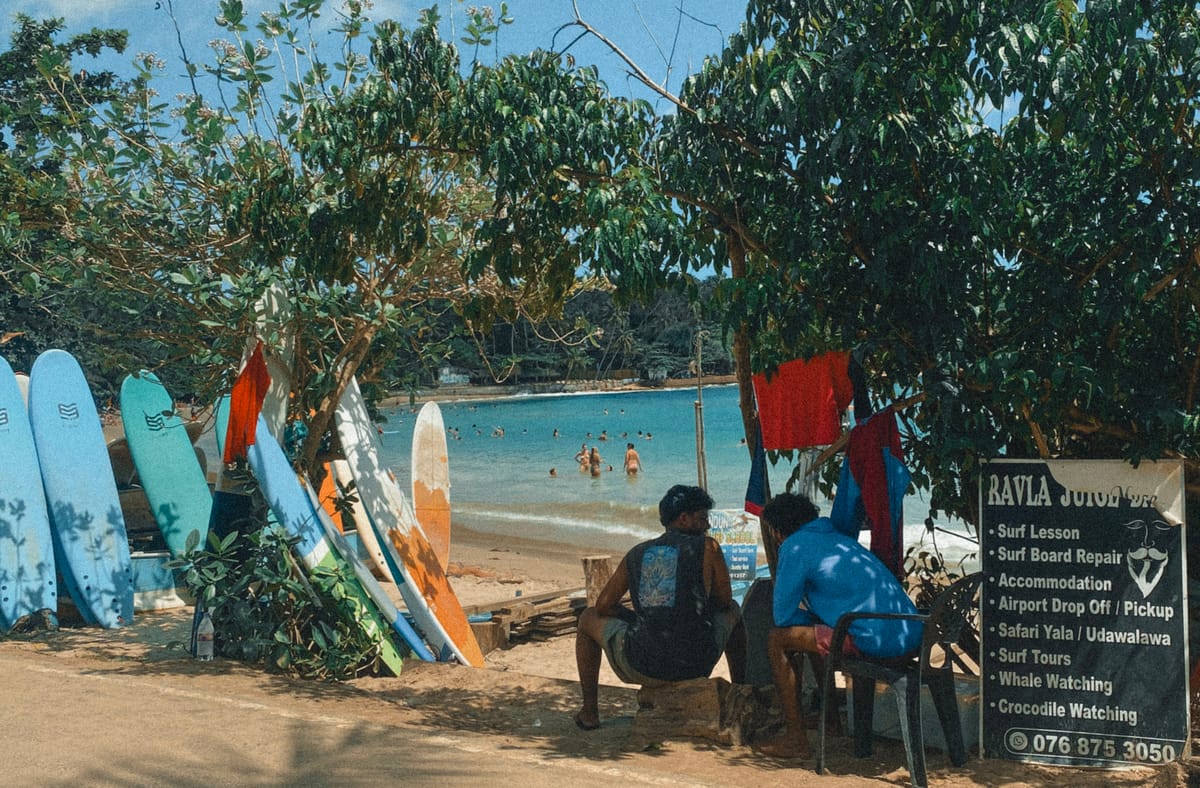
"Tell all your friends to come to Sri Lanka."
The sentence flows through the air of the island. Through tuk-tuks, along beaches, and in safari jeeps — like a slogan written in the tropical sky.
In mid-November, this leaves a taste of hope in my mouth, a refreshing perspective amid Europe’s seeming descent into despair. Worry, masked as frustration and anger, clings to people’s faces. In the screaming media, in the streets and tense conversations. Despair — like a slogan written in the grey sky.
On the island, we are handed tea, strong and black, or a fresh coconut carved into the shape of a mouse.
A small act of Sri Lankan hospitality given with a wide smile, one that would stretch along our entire journey, from Colombo to the south and back. A smile that seals the struggles of the past and shines with resilience.
It is easy to come to the white beaches and crashing waves, without ever knowing about the civil war that raged for twenty-six years, leaving a scar of war crimes in the country's heart.
With the war ending in 2009, the island began to heal — although for many the wounds remain fresh — and tourism returned. Small guesthouses, surf camps, cafés, and transport businesses appeared like mushrooms after rain, driven by urgency and a collective desire to move forward. At the same time, large hotels and resort developments advanced rapidly, backed by significant investment and accelerated planning processes.
Tourism became one of the fastest ways to rebuild the economy; numbers quintupled in only 10 years, reaching almost 2.5 million visitors by 2019.
On Easter Sunday of the same year, tourists queued at the breakfast buffet at the Taprobane restaurant in the Cinnamon Grand hotel in Colombo as explosions went off, targeting hotels and churches, leaving at least 290 people killed, and the country in shock. The Easter bombings caused tourism to collapse almost overnight.
Fear cancelled bookings and closed businesses, only a year before the COVID-19 pandemic shut borders entirely. Sri Lanka was hit by the brutal waves of its worst economic crisis.
Stories of long lines at gas stations, days without fuel or electricity, and ever-rising inflation still linger like ancestral ghosts.
In 2022, the government's mismanagement and corruption drove thousands of people into the streets. Protests, which led President Gotabaya Rajapaksa to flee the country.
As Sri Lankans exhale, hope returns on fragile branches, once again. Tourism is held up as the island’s promise, fueling investments into new bridges, roads, and ports.
We travel south during the shoulder season, when the monsoon begins to move north. November marks the transition between the island's two seasons. As heavy rains stream across the north, seasonal workers stream south to tourism hubs like Mirissa and Ahangama, where the sun announces the high season beginning in mid-December.
Working in a seasonal tourism destination, I recognize the gulf. Incoming tourists mean incoming money, money that might need to last through wet, money-dry months, used to pay off debts, to repair homes, to reinvest in fragile business ideas.
As a chatty receptionist myself, my conversations with local staff often turn quickly to work, a shared bond, a joke about guests you can only make with people in the industry.
Yet I am caught by the moments when words abruptly fade, sentences cut short, like trees illegally trimmed. Some truths are left unspoken, buried beneath that warm, familiar smile. For the pressure to make sure the guest, in this scenario, me, has the best possible experience, unburdened by politics, precarity, or the uncomfortable question of my own role in an industry as double-edged as a sword.
Our host in Kandy once said that in Sri Lanka, people do not die of hunger; there is food everywhere. A jackfruit tree feeds humans and monkeys alike.
And yet, for many young Sri Lankans, future perspectives are limited, with 2024 recording the highest number of Sri Lankans migrating abroad for employment in the nation's history.
For our waiter, much of what Sri Lanka offers is inaccessible. When I ask why he'd leave all this, the palm-fringed beaches, the iguanas visiting throughout the day, the tea hills, fruit trees, and kindness, he doesn't hesitate: "I cannot afford my own country."
Not the surfing, the snorkelling, the whale watching, packaged as experiences. The yoga studios, concept stores, and cafés, sometimes more expensive than in Europe, are not designed for him.
I hear of places that only allow tourists; while it is illegal to discriminate based on race or nationality, selection also happens subtly — through high prices, dress codes, and guest-only policies.
Those who stay often work in tourism, running multiple businesses, from tours and taxis to accommodations. Whenever I share my own entrepreneurial dreams, I am encouraged to come to Sri Lanka. To invest here. To partner with a local, because foreigners cannot buy land alone.
Land is still affordable, for those who can afford it.
On the highway from Ahangama to Colombo, our driver keeps stopping repeatedly to point out cinnamon trees, jackfruit, mangos, and tea fields. He is determined to turn the ride into a sightseeing tour, ‘to give us the best experience’.
His dream, he says, is for Sri Lanka to become Bali 2.0. He speaks of accommodation ideas, DJ projects, and marketing videos. Each interaction with a tourist holds the possibility of connection, opportunity, and partnership. A mindset shaped by necessity and hope, to build a better life for oneself, for family, for Sri Lanka.
And yet, like a dark cloud, fear hovers. Of overtourism. Of land degradation. Of local displacement. What is one person’s innocent dream is another’s skeptical question: who truly benefits from inevitable growth?
Sri Lanka stands at a crossroads. Its potential is undeniable, its future uncertain. The question is not whether tourism will grow, but whether it can do so responsibly, without eroding the culture and ancient rhythms that make the island what it is.
That evening in Colombo, exhausted from exploring the city all day, the daylight fades gently into night as the sun sets over the Galle Face Green. Food vendors sell ice cream to families, and couples lounge along the promenade.
At the Gallery Café, art-lined walls catch the visitor´s eye. Cosmopolitan chic and easy laughter fill the space. Outside, the city mumbles, absorbed in its own momentum, not yet aware of the storm to rise.
On Thursday evening, our flight took off nearly on schedule, even as heavy rain and strong winds jolted the area.
Earlier that day, Sri Lanka's Department of Meteorology had issued a red alert, and text messages beeped on my phone, warning of the need to take necessary measures to protect oneself.
The first reports began trickling in, of landslides and flooding, predicting a tragedy that would ultimately affect millions, displace thousands, and claim over 620 lives.
The central highlands around Kandy, where we had been welcomed with open arms just two weeks earlier, were among the areas hit hardest. Our host reported days without water or electricity, helicopters circling overhead, rescuing people from their homes.
The news would later call it the worst natural disaster since the 2004 tsunami. Another devastating fracture in a country still rebuilding itself.
Days later, as cleanup work began, a song circulated online, writing a new chapter of resilience into the unfinished story of Lanka.
Climate scientists are examining how much of Cyclone Ditwah's wreckage can be attributed to climate change. While monsoons and storms have always been part of this region's seasons, warming temperatures are intensifying both rainfall and wind speeds, turning typical weather patterns into catastrophic events.
It is the Global South that suffers most from the consequences; nations that have contributed least to climate change yet pay the highest price.
Now tourism is needed — to bring money into the country, to rebuild what has been destroyed, to help families and small businesses recover. Another layer in the story of paradise.
BOOKS / MUSIC / PODCASTS / FILMS / ARTWORK
The Island of Missing Trees — Elif Shafak
One of those books I cannot put down. Maybe it is my love for islands, or perhaps it is Shafak's lyrical writing. The way she braids the personal and political, allowing a fig tree to hold the memory of a divided Cyprus. It is a novel about love, displacement, and the ways trauma travels through generations.
The Nature Of — with Willow Defebaugh
A relatively new podcast from Atmos, and already a favourite. The thoughtful conversations on what nature can teach us, with guests like Robin Wall Kimmerer, Roxane Gay, and Adrienne Maree Brown feel grounded rather than urgent. It's a kind of listening that slows you down and makes you think. I especially enjoyed the episode with Kate Marvel. I listen on Podimo.
Lux — Rosalía
The hype is real. Rosalía’s latest album, Lux, is a piece of art, exploring spirituality and transformation, revealing its depth only through repeated listening.
As the year draws to a close, I am grateful for another year of your attention and presence here. I am wishing you warm and cozy holidays, wherever you find yourself. See you in the new year.
With love, Zaza